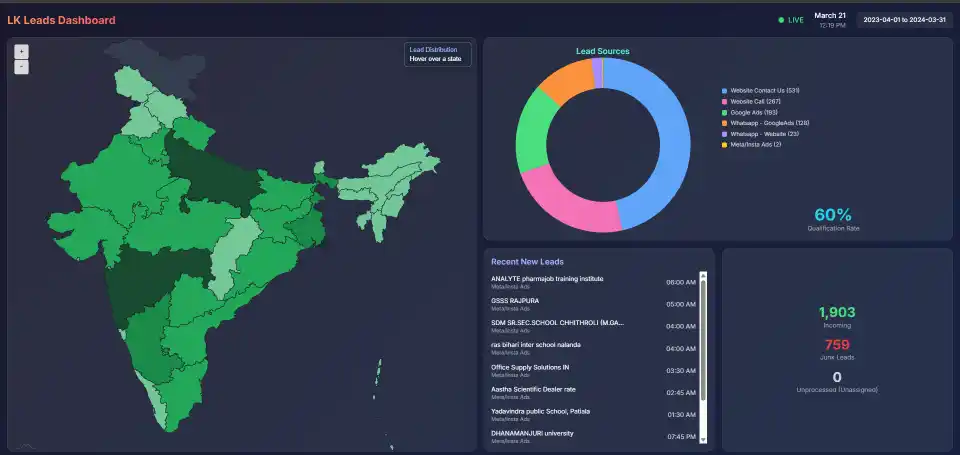
FY 2023–24
1,903 leads
60% qualification rate
Performance Marketing Case Study
A three-financial-year performance marketing transformation — from unreliable conversion tracking and declining lead flow to 6,514 annual leads with qualification recovering to 59%.
Client

Duration
FY 2023–24 to FY 2025–26
Primary channels
Google Ads · Meta Ads
Geography
Pan India
Result at a glance
The raw lead numbers show the shift clearly. FY 2024–25 declined from the previous year, while FY 2025–26 became the strongest lead-generation year in the period.
FY 2023–24
1,903 leads
60% qualification rate
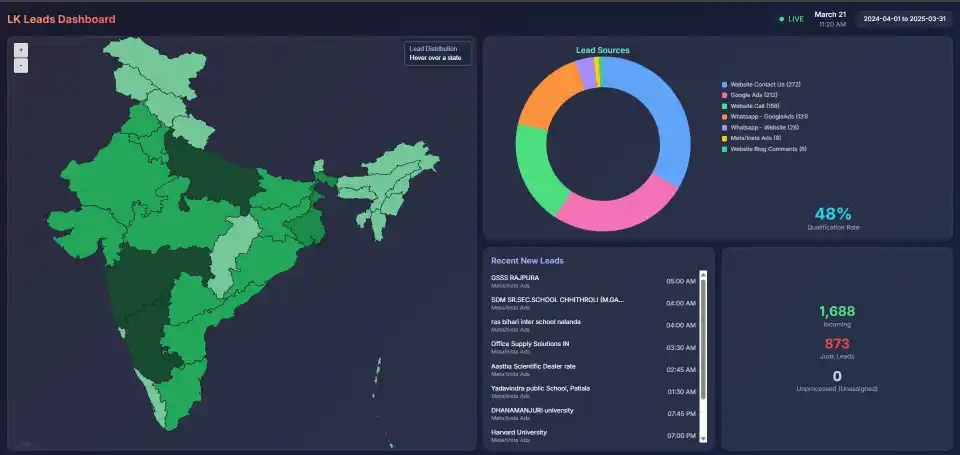
FY 2024–25
1,688 leads
48% qualification rate
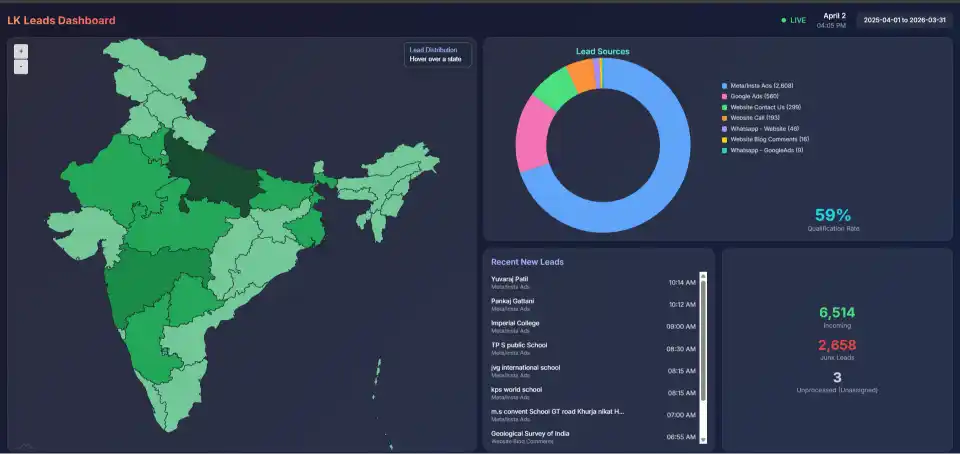
FY 2025–26
6,514 leads
59% qualification rate
The challenge
The bigger issue was that the acquisition system could not clearly distinguish real business outcomes from noisy platform activity. That made budget decisions harder and sales follow-up less efficient.
Annual leads fell from 1,903 to 1,688, while qualification dropped from 60% to 48%.
The account showed roughly 239,000 “conversions”, but many were micro-events such as page views, video views and scrolls rather than actual leads.
Only ₹9,413 had been spent on Meta in FY 2024–25, with just 8 tracked leads. The channel had not yet been used as a serious acquisition engine.
With a 52% junk-lead rate in FY 2024–25, high volume alone would not solve the sales team's problem.
What the data revealed
The diagnosis changed the strategy. Google needed cleaner measurement. Meta needed a real test. Lead quality needed to be treated as a campaign signal, not only a sales complaint.
Campaign optimisation was being influenced by non-lead actions, which made reported performance look far better than the actual pipeline.
239Kreported “conversions” in the old setup
The low spend and limited lead activity were not enough evidence to judge the channel's real B2B potential.
₹9.4KFY 2024–25 Meta spend
Campaign optimisation had to account for whether leads were useful to sales, not simply whether a form was submitted.
52%junk-lead rate in FY 2024–25
What I changed
The strategy was less about adding more campaigns and more about improving measurement, channel roles, creative relevance and qualification.
Removed micro-events from the primary conversion set and re-centred optimisation around actual lead submissions.
Moved beyond awareness activity with lead forms, audience segmentation and creative testing focused on schools, colleges and laboratories.
Ads addressed practical high-intent questions such as science-lab setup cost and complete laboratory solutions.
Google spend was reduced and more budget was moved toward Meta once the channel demonstrated a lower lead-acquisition cost.
Audience exclusions, negative-keyword hygiene and qualification questions were used to reduce irrelevant enquiries while scaling volume.
Google Ads
The biggest Google Ads change was not cosmetic. The conversion framework was rebuilt so campaign reporting reflected lead-generation activity rather than a mix of micro-events.
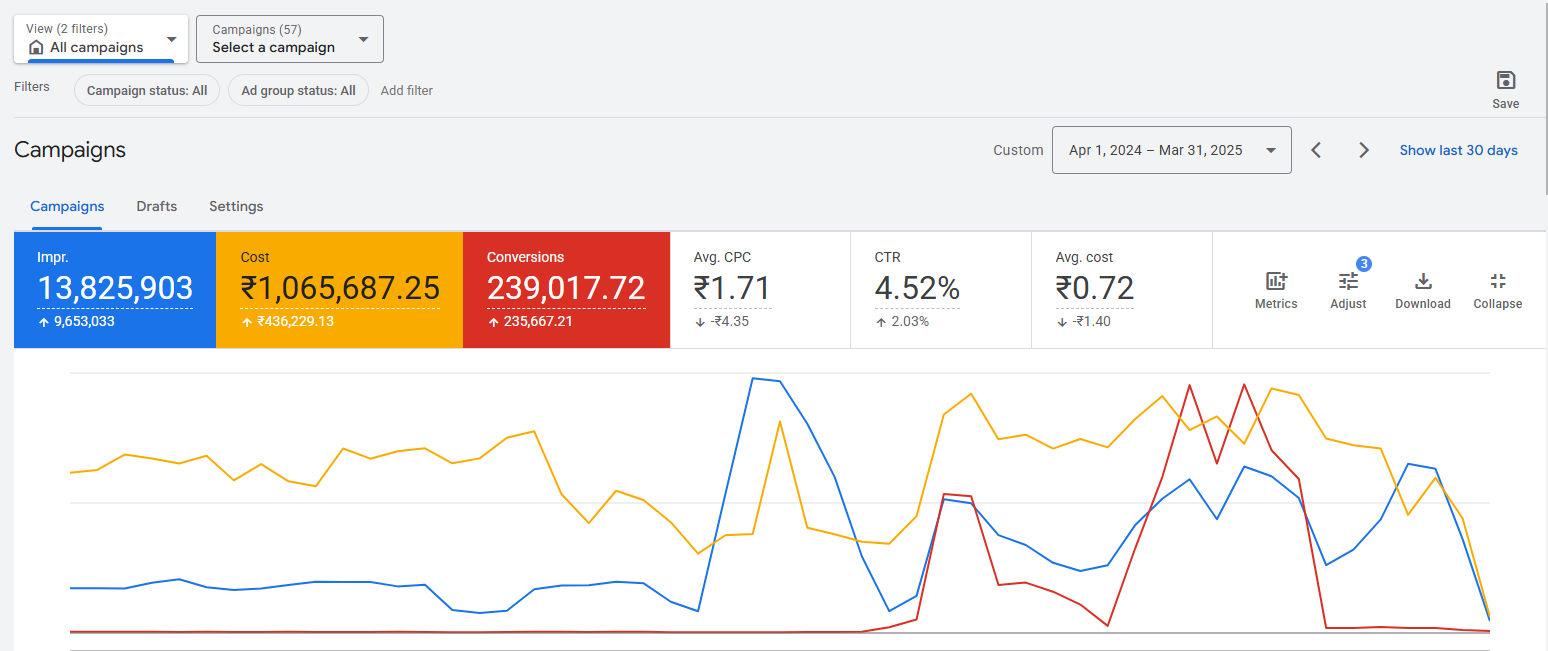
Before · FY 2024–25
Micro-events such as page views, video views and scroll depth were included in the conversion set.
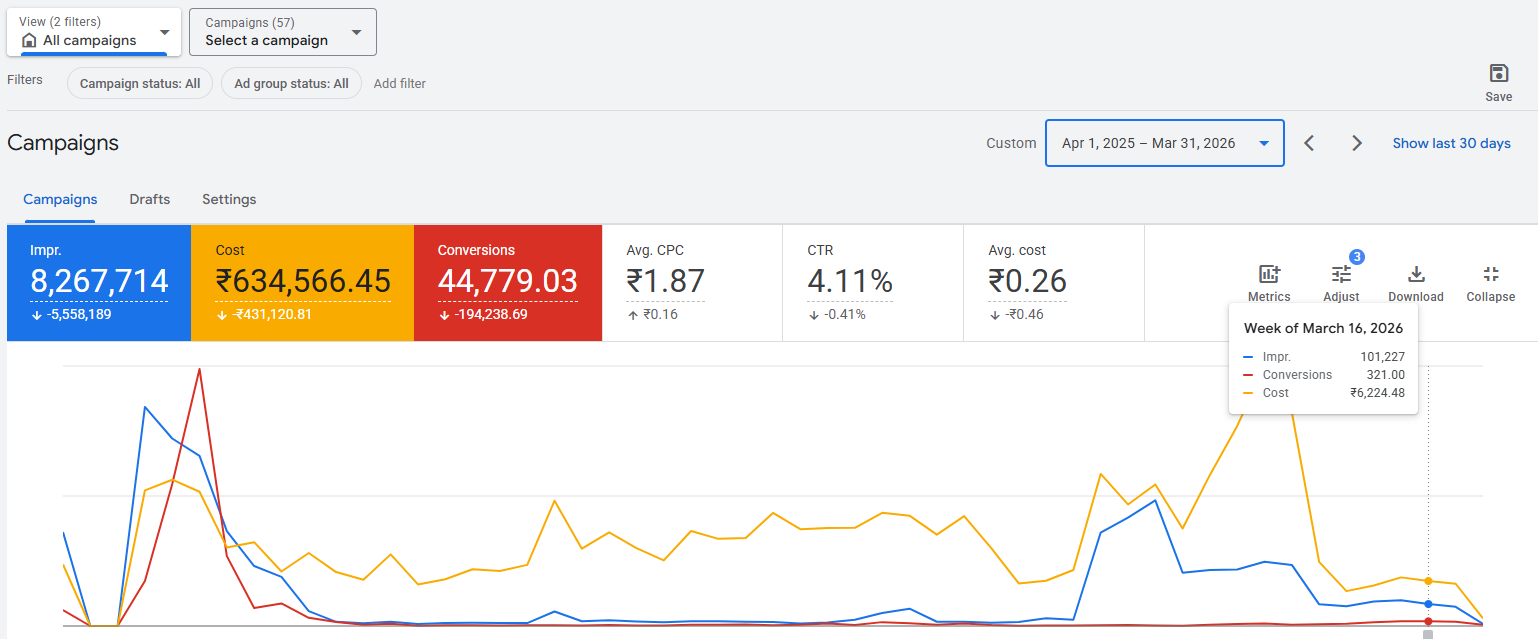
After · FY 2025–26
Primary conversion tracking was cleaned up and campaign optimisation was aligned more closely with actual lead generation.
Meta Ads
Once Meta was treated as a serious acquisition channel, spend could be scaled with a clearer creative, audience and qualification framework.
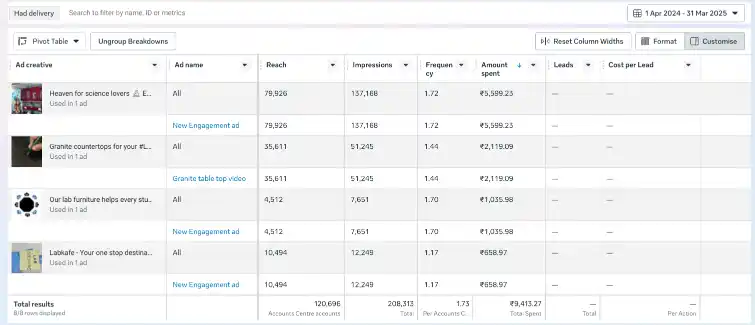
Before · FY 2024–25
Spend was too limited to establish the channel as a meaningful B2B acquisition source.
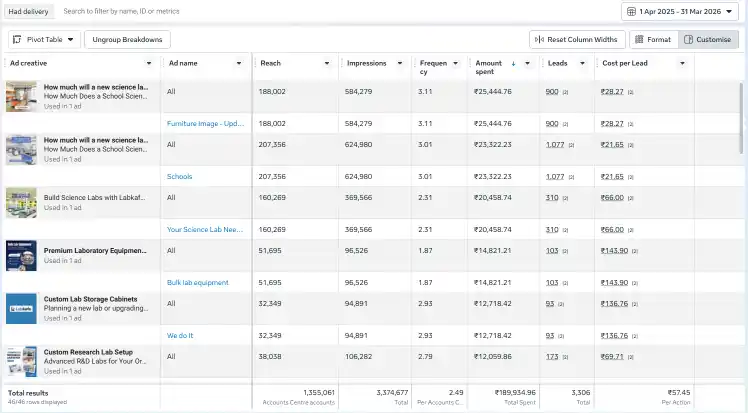
After · FY 2025–26
Spend was scaled only after the channel demonstrated it could generate volume at an efficient cost.
The outcome
The strongest improvement was not one isolated campaign. It was a more measurable acquisition system that made it easier to see which channels and messages deserved more investment.
What I learned
The case reinforced that performance marketing decisions become much stronger when measurement, channel testing and sales-quality feedback are treated as one system.
If the optimisation signal is wrong, even a well-built campaign can move in the wrong direction.
Meta looked insignificant until it was given enough budget, structure and creative testing to prove its role.
Volume becomes useful only when qualification and junk-lead rates are monitored alongside acquisition cost.
Let’s talk through the data, the funnel and the most practical way forward.